
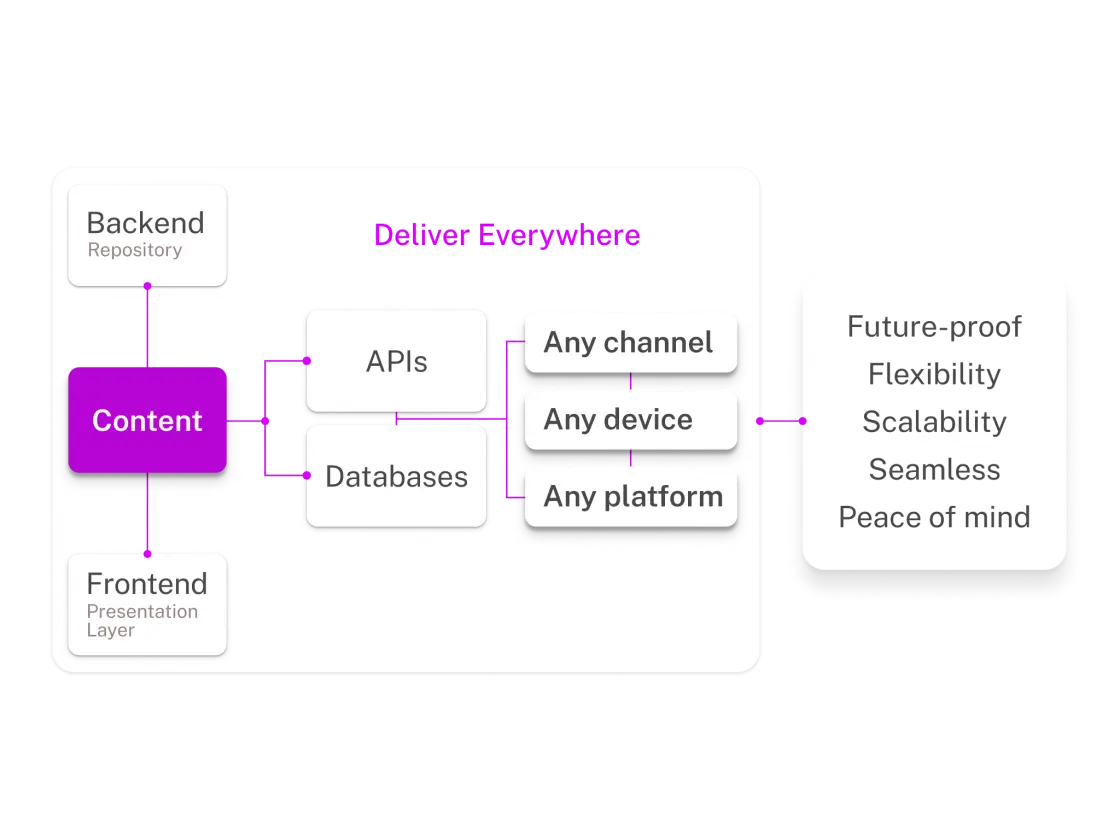
FirstSpirit CMS embraces a decoupled architecture,
strategically separating the content repository (backend) from the presentation layer (frontend).
This fundamental design principle unlocks significant advantages for complex international businesses.
Unleash Limitless Potential
with a Decoupled Architecture

Universal Flexibility
Deliver content to any channel, device, or platform – now and in the future. Whether it's websites, mobile apps, single-page applications (SPAs), IoT devices, or emerging technologies, FirstSpirit's decoupled nature ensures seamless content delivery without platform limitations.

Technology Agnosticism
Empower your developers to utilize their preferred frontend technologies and frameworks. This freedom fosters innovation, accelerates development cycles, and allows you to adapt swiftly to evolving technological landscapes.

Enhanced Performance
Decoupled architectures optimize performance by allowing independent scaling of the backend and frontend. This ensures lightning-fast content delivery and superior user experiences, regardless of traffic volume or channel complexity.

Future-Proofing
By isolating content from presentation, FirstSpirit future-proofs your digital investments. Evolve your frontend technologies without impacting your core content infrastructure, ensuring long-term agility and reduced redevelopment costs.
FirstSpirit CMS offers the best of both worlds
with its hybrid headless
capabilities.
You gain the flexibility of a pure headless CMS for API-driven content delivery while retaining the familiar and intuitive authoring environment that marketers need.
Testimonial
For over 20 years, I have worked with FirstSpirit. For me it's still one of the most flexible and reliable CMS. I particularly appreciate the static pre-generation approach, which enables a clean separation of the editorial system and the web application, as well as seamless integration into arbitrarily complex IT landscapes.

Embrace
the Power of Hybrid Headless

Granular Control
Manage and structure your content with precision in the central FirstSpirit repository, ensuring consistency and brand adherence across all touchpoints.

Marketer Empowerment
Equip your marketing teams with powerful in-context editing tools and intuitive workflows, enabling them to create, preview, and publish content efficiently without relying on developers for every update.

Scalable Delivery
Leverage APIs (GraphQL and REST) to distribute content to any frontend system, ensuring optimal performance and scalability for diverse digital experiences.

Seamless Integration
Integrate effortlessly with your existing marketing technology stack, including CRM, personalization engines, analytics platforms, and more, creating a unified and powerful digital ecosystem.
Built for Enterprise Scalability and Global Reach
FirstSpirit CMS is architected to handle the most demanding content management challenges of global organizations:
Scalability & Performance

Horizontal Scalability
Effortlessly scale your platform to accommodate growing content volumes, increasing traffic, and expanding digital initiatives. Our SaaS infrastructure is designed for high availability and performance, ensuring business continuity.

Multisite Management
Centrally manage content for multiple brands, regions, and languages from a single FirstSpirit instance. Streamline localization workflows, maintain brand consistency, and accelerate time-to-market for global campaigns.

Robust Security
Benefit from a secure SaaS environment with enterprise-grade security measures, including data encryption, access controls, and regular security audits. Trust FirstSpirit to protect your valuable content assets.

Global Content Delivery Network (CDN)
Ensure fast and reliable content delivery to users worldwide through our integrated CDN capabilities, optimizing performance and user experience regardless of location.
Secure SaaS Foundation for Peace of Mind
Delivered as a secure Software-as-a-Service (SaaS) solution, FirstSpirit CMS offers numerous advantages.
Benefits of Software-as-a-Service

Reduced IT Overhead
Eliminate the complexities and costs associated with on-premise infrastructure management, including hardware, software updates, and maintenance.

Automatic Updates
Benefit from continuous innovation with automatic software updates and feature enhancements, ensuring you always have access to the latest capabilities.

High Availability and Reliability
Our robust SaaS infrastructure provides high uptime and reliability, ensuring your digital experiences are always available to your customers.

Flexible Subscription Models
Choose subscription plans that align with your business needs and scale as you grow, offering cost-effectiveness and predictable budgeting.
Learn more
What is decoupled architecture?
In a decoupled CMS, the
front-end presentation layer and the back-end content management system are separated
- so how the content is presented is irrelevant. A decoupled approach offers the advantage of pushing content to a
ny touchpoint in any front-end technology
with these sites running independent of the CMS.
When implementing a decoupled architecture with FirstSpirit several specific advantages arise. FirstSpirit decouples content management and presentation layers, enabling content to be created and managed independently from how it is displayed on websites or applications. This separation empowers organizations to deliver a consistent and personalized user experience across various platforms, such as websites, mobile apps, and digital signage.
Moreover, FirstSpirit leverages APIs to facilitate the integration of different systems and services. This enables developers to utilize modern frontend technologies and frameworks, thereby enhancing the user interface without being constrained by the backend. The system's extensibility allows for the addition of plugins and custom functionalities tailored to specific business needs.
In summary, decoupled architecture, particularly when integrated with FirstSpirit, offers businesses the agility to respond to changing market demands while enhancing the overall performance and user engagement of their digital platforms. This approach is particularly beneficial for organizations aiming to build robust, future-proof applications that can adapt to evolving technological landscapes.
When do you use headless versus classic static delivery?
When considering the delivery methods for content management using FirstSpirit CMS and
Content as a Service
(CaaS), it's essential to understand the distinctions between headless and classic static delivery.
Headless Delivery
offers a flexible and dynamic approach to content rendering. This method decouples the backend from the frontend, allowing for seamless integration with modern frameworks and applications. It's particularly advantageous for projects requiring personalized user experiences and rapid updates. If your organization is focused on multi-channel delivery—spanning web, mobile apps, and IoT—headless delivery ensures that content can be adapted and served through APIs, leveraging the latest technologies.
On the other hand,
Classic Static Delivery
is ideal for traditional web projects where content is primarily served on websites without the need for customization. This method simplifies the deployment process, making it suitable for smaller-scale projects or scenarios where content is less frequently changed. If your focus is on static websites with straightforward content needs, classic static delivery remains more efficient and easier to manage.
Choosing between these two methods ultimately depends on your project's requirements, audience, and the expected frequency of content updates. Organizations aiming for cutting-edge user experiences may lean towards headless delivery, while those with simpler needs might find classic static delivery more effective. However, it's also possible to
combine headless and classic static delivery
to leverage the strengths of both approaches.
By integrating elements of headless delivery for dynamic content needs while utilizing classic static pages for more stable content, organizations can create a flexible structure that addresses varied user demands. Understanding the strengths and limitations of each will assist in making an informed decision that aligns with your content strategy.