More output was never the problem
AI has become an indispensable part of content creation for most teams. However, in many cases, it hasn’t yet truly paid off. Find out why that is—and where AI can actually save you money—in our series “The ROI of Controlled AI.”
The question of whether artificial intelligence should be integrated into the content creation process is hardly ever openly debated anymore. It has now been settled. Drafts are created in a matter of minutes, translations take place in the background, and metadata is generated almost automatically.
Nevertheless, there remains an unspoken question in many marketing and content teams: "What benefits did we actually derive from this?"
This isn't skepticism toward AI. Rather, it's an honest assessment. The technology is here, output has increased—but the return on investment is often difficult to measure. This is precisely the gap we're trying to bridge in our series "The ROI of Controlled AI."

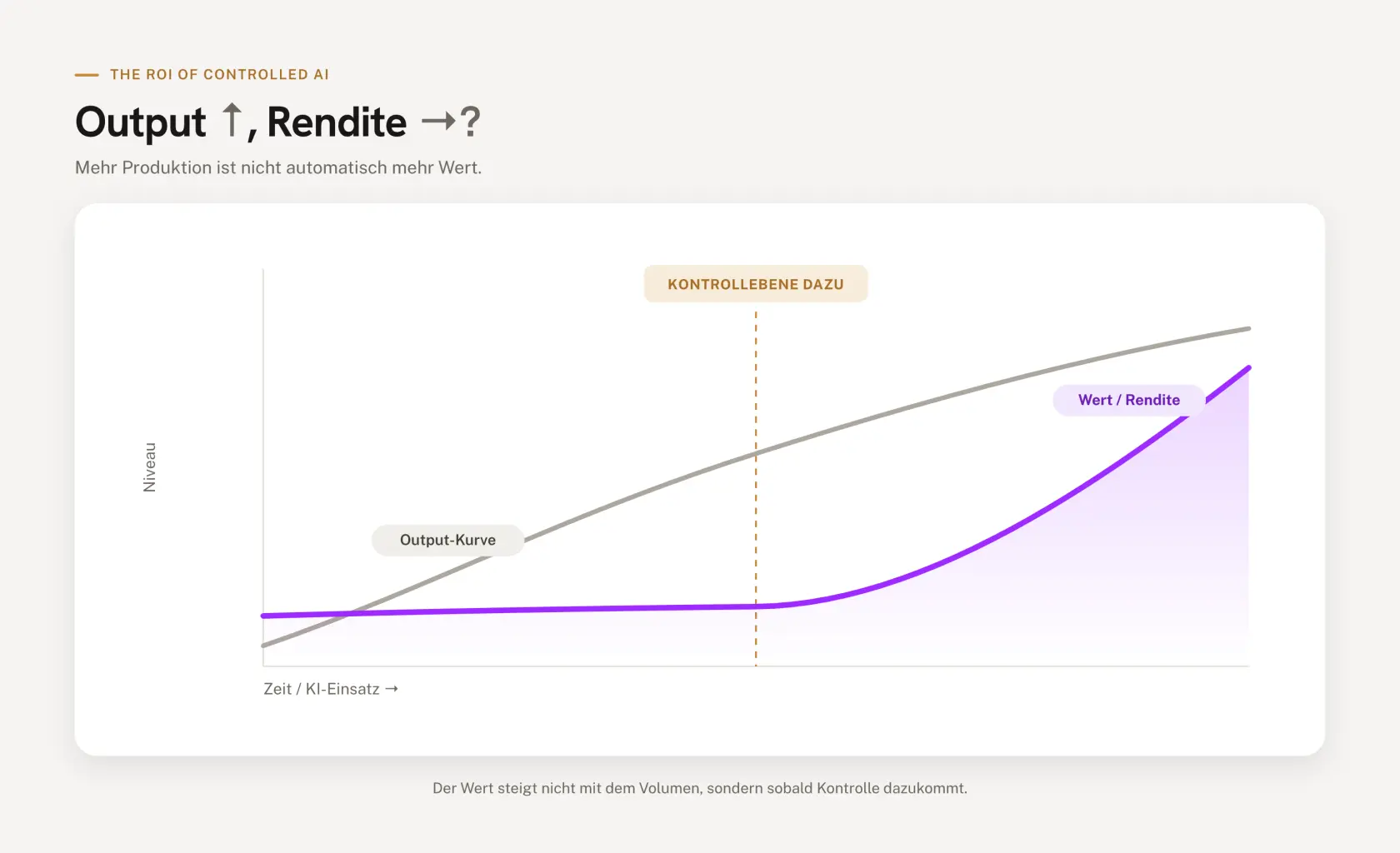
More output does not equal a return
The mistake lies in the metric. AI is implemented to boost production—and then measured in terms of speed, as if that were the result. But it isn't.
A content team was rarely slow because it lacked drafts. It was slow because every publication had to go through coordination, approval, brand review, and system limitations. AI is now speeding up production. The governance behind it is not.
Two groups are familiar with this outcome from their own daily lives:
Companies that are already using AI on a large scale are producing more content variations across more languages and channels—and are realizing that no one has a complete overview of what is being said under the brand’s name and where. The pace is there. Control is lacking.
For those just getting started, a crucial decision looms: Either implement artificial intelligence quickly and comprehensively and introduce controls later—or design the system from the outset so that speed and control form a functional whole.
In both cases, it is not the volume of output that determines the ROI. What matters is how much of it can actually go live without rework, without compromising the brand, and without risk.
What the Research Shows
It’s worth taking a look at the reliable studies here—not at the promises in the “revolutionizes everything” category.
Controlled studies show significant time savings for clearly defined tasks. For professional writing, Noy and Zhang (Science, 2023) reported a time reduction of about 40 percent—while the quality was rated higher. For programming tasks, Peng et al. (2023) measured time savings of about half the processing time. For the post-editing of machine translations, the work by Plitt and Masselot (2010), which reported a time savings of about 43%, remains the benchmark to this day.
A second finding runs through the data and is at least as important for ROI: the greatest gains are achieved where experience is lacking. In a large-scale field study, Brynjolfsson, Li, and Raymond (2023) found the most significant gains among less experienced employees. AI acts as a balancing lever—it boosts the team’s performance in areas where specialized knowledge was previously the bottleneck.
But—and this is the part the “output narrative” tends to skip over—the same research draws a clear line. Dell'Acqua et al. (2023) describe a “jagged frontier”: Within its area of expertise, AI makes work faster *and* better. Outside of that, quality declines—especially when people blindly trust the results.
That's exactly where the circle closes. The studies do not show that more AI means more value. They show that value is created when AI operates within the right framework and a human sets the limits. Keyword: Human in the Lead.

Control is the key
This evidence leads to a liberating realization: The ROI of AI in content doesn’t come from maximum output. It comes from output you can trust—brand-aligned and consistent, even across numerous markets with dozens of channels.
The common reaction to the threat of losing control is to slow down AI or lock it away centrally. This merely shifts the problem to shadow workflows, where work is done without guidelines. Governance that is too rigid is circumvented. Governance that is too open allows the brand to lose its way.
The truth lies in the golden mean: barriers that support processes rather than blocking them. Control thus transforms from the antithesis of speed into its prerequisite. Speed arises from control.
The correct term for this is not “Human in the Loop,” but “ Human in the Lead .” AI handles the execution. Humans take the lead: setting the direction, making judgments, assuming responsibility, and giving approval. Nothing goes live unless a human has taken responsibility for it.
That’s the point at which an AI experiment becomes a robust process. And it’s the point at which managing complexity pays off: transparent, repeatable, and verifiable—across brands, markets, and systems.
Conclusion
More output has never been the problem. Managing complexity is the real challenge—and that’s exactly where AI’s ROI in content lies.
Anyone who wants to ensure AI is used responsibly in enterprise environments doesn't need yet another tool that just adds to the volume. They need a framework that balances speed and control and makes both measurable. That way, AI becomes not a risk, but a demonstrable return on investment.
Webinar: "The ROI of Controlled AI"
Timo Klattenhoff and René Voß will explain how to manage the complexity described on September 1, 2026, at 3:00 p.m.